Unit 4: Social Psychology and Personality
Topic 4.2: Attitude Formation and Attitude Change
The Big Picture: Beliefs into Action
Our attributions from Topic 4.1 often lead us directly to our attitudes. An attitude is a set of feelings and beliefs that generally guide how we react to specific people, objects, or events. Psychologists view attitudes as having three main components: affective (how we feel), behavioral (how we act), and cognitive (what we believe). In this topic, we will explore how we form these attitudes, how outside influences can persuade us to change them, and the psychological tension that occurs when our attitudes and actions don't align.
1. Persuasion: Changing Minds
Every day we are bombarded by attempts to change our attitudes, whether it's a politician asking for our vote or a commercial convincing us to buy a new product. Persuasion generally travels through two main pathways:
- Central Route to Persuasion: Occurs when people focus on the factual content, logic, and actual arguments of a message. It requires the audience to be analytical and involved. Example: Buying a car because you researched its excellent gas mileage and safety ratings.
- Peripheral Route to Persuasion: Occurs when people are influenced by incidental, superficial cues rather than the facts. This works best when the audience is not deeply engaged. Example: Buying a car because a highly attractive celebrity is driving it in the commercial.
2. Compliance Strategies: Getting to "Yes"
Beyond general persuasion, social psychologists study specific strategies people use to get others to comply with their requests. Understanding these phenomena can explain how small actions drastically alter our long-term attitudes:
- Foot-in-the-Door Phenomenon: The tendency for people who have first agreed to a small request to comply later with a larger request. By getting you to say "yes" to something tiny, the persuader starts shifting your attitude so that you view yourself as the "kind of person" who helps them. Example: A friend asks to borrow your notes for one class (small request). Next week, they ask you to tutor them for 3 hours (large request).
- Door-in-the-Face Phenomenon: The strategy of starting with an unreasonably large request that is almost guaranteed to be rejected, and then following up with a much smaller, more reasonable request. The second request seems like a compromise. Example: Asking your parents for $500 to go on a trip. When they say absolutely not, you ask for $20 to go to the movies.
3. Cognitive Dissonance Theory
What happens when our actions directly contradict our deeply held beliefs? According to psychologist Leon Festinger, we experience cognitive dissonance. This is a state of psychological tension or discomfort that occurs when a person holds two inconsistent thoughts or when their behavior is contrary to their attitudes.
Because humans hate this feeling of tension, we are highly motivated to resolve it. We typically do this not by changing our behavior (since it already happened), but by rationalizing our actions or entirely changing our underlying attitude to match what we just did. Example: You believe cheating is morally wrong, but you peek at your neighbor's test anyway. To reduce the guilt (dissonance), you convince yourself that "the test was unfair anyway, so it doesn't really count as cheating."
4. The Power of Roles
Our attitudes are profoundly shaped by the social roles we step into. A role is a set of expectations about how people in a specific social position should behave. When we adopt a new role, we quickly adopt the attitudes that accompany it.
The most famous (and highly controversial) demonstration of this was Philip Zimbardo's Stanford Prison Experiment. College students randomly assigned to be "guards" or "prisoners" quickly adopted the aggressive or submissive attitudes expected of those roles, taking the simulation so seriously that the experiment had to be shut down early. It revealed a striking truth: what we do, we gradually become.
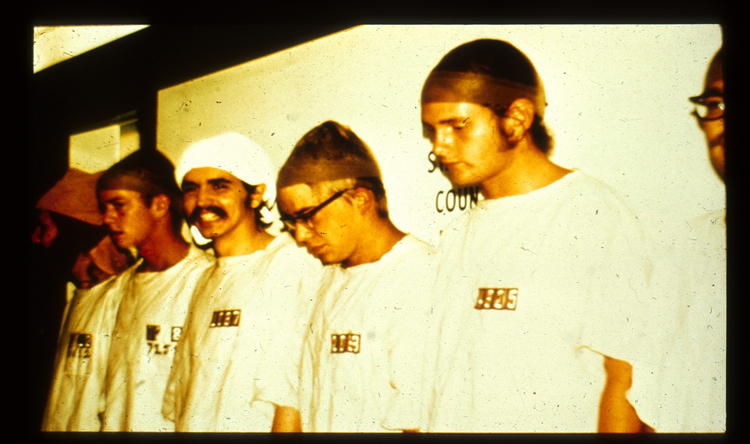
The Stanford Prison Experiment and the Power of Roles. Conducted by Philip Zimbardo in 1971, this landmark study randomly assigned roles of guards and prisoners to college students in a simulated prison environment. The experiment demonstrated how powerfully assigned social roles and situational variables can compel individuals to conform to expected behaviors, often overriding internal personality traits. The rapid internalization of roles, sometimes leading to abusive or compliant behaviors, highlights critical concepts within AP Psychology's exploration of social roles (Topic 4.2).
5. Don't Trip Up! (Common Misconceptions)
⚠️ Foot-in-the-Door vs. Door-in-the-Face: Students frequently mix up these compliance strategies on the exam. A helpful trick: The Foot-in-the-Door starts small (like just getting your foot across the threshold) and gets bigger. The Door-in-the-Face starts huge (so big the person slams the door in your face) and gets smaller to ask for a compromise.
6. Level Up Your Score: Unit 4 Prep
Persuasion strategies and cognitive dissonance are AP Psych staples. Test your understanding of attitude formation before you move on to group dynamics:
- Persuasion Pathways: Jump into a round of Connections to categorize real-world examples into central vs. peripheral routes of persuasion.
- Dissonance Detectives: Play Oddball to spot the true examples of cognitive dissonance hidden among tricky distractors.
- Compliance Clash: Head to Confusing Pairs to master the exact differences between Foot-in-the-Door and Door-in-the-Face strategies!