Unit 3: Development and Learning
Topic 3.9: Social, Cognitive, and Neurological Factors in Learning
The Big Picture: Moving Beyond the Box
Classical and operant conditioning both rely on direct experiences—you are the one hearing the bell, and you are the one receiving the reward or punishment. But human (and animal) learning is far more complex than simply reacting to direct stimuli. We also learn by thinking, processing, and watching the world around us. This final topic of Unit 3 bridges the gap between behaviorism and cognitive psychology, exploring how internal thoughts and social observations dictate our behavior.
1. Learning by Watching: Social Learning Theory
Albert Bandura challenged strict behaviorism by proposing Social Learning Theory, which argues that learning is a cognitive process that frequently occurs through observation, rather than requiring personal experience with a direct consequence.
At the heart of this theory is Modeling—the process of acquiring new behaviors by actively observing and imitating the actions of others. Research demonstrates that we don't just mimic anyone; the more similar a model is to the observer (in age, gender, or perceived status), the more likely the behavior is to be successfully learned and replicated.
Vicarious Consequences
We do not need to be personally punished to know a stove is hot. We can learn through Vicarious Conditioning, which occurs when an individual observes the consequences (either rewards or punishments) that another person receives for their behavior, and subsequently adjusts their own behavior accordingly. If you watch a classmate get praised for raising their hand, you become more likely to raise yours.
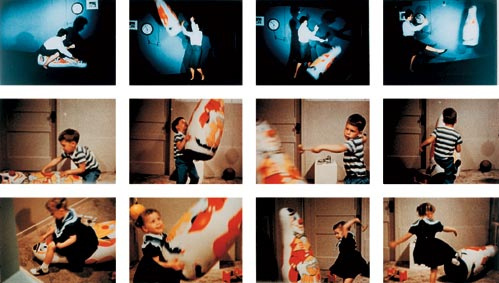
The Bobo Doll Experiment. Bandura's classic study showed that children who observed an adult aggressively hitting a Bobo doll were highly likely to imitate that exact aggressive behavior when placed in a room with the doll themselves.
2. Cognitive Factors: Thinking About Learning
Strict behaviorists believed that learning could not happen without a tangible reward. However, cognitive psychologists proved that our brains are constantly processing and storing information in the background, even when there is no immediate incentive to do so.
Latent Learning and Cognitive Maps
A classic example of hidden learning is Latent Learning—learning that occurs without any immediate reinforcement or obvious demonstration. This knowledge remains hidden in the background but becomes instantly apparent the moment there is a motivation or reward to show it.
Latent learning is often demonstrated through the creation of Cognitive Maps, which are internal, mental representations of the layout of physical spaces or environments. For example, if you walk around a new school for a week without paying much attention, you are subconsciously building a cognitive map. You might not demonstrate this knowledge until a teacher offers you a piece of candy to quickly run a pass to the main office—suddenly, you know exactly which hallways to take!
The "Aha!" Moment
Sometimes, learning doesn't happen gradually through shaping or repetition. Insight Learning occurs when the solution to a problem suddenly becomes clear without any prior trial-and-error, association, consequence, or modeling present. This is the classic "aha" moment when the pieces of a puzzle simply snap together in your mind.
Topic 3.9 Review. This video breaks down the key components of social and cognitive factors in learning, exploring how we learn through observation and hidden mental processes.
3. Don't Trip Up! (Common Misconceptions)
⚠️ Vicarious Conditioning vs. Operant Conditioning: It is easy to mix these up on the AP Exam! Remember that in Operant Conditioning, the learner is the one who directly receives the consequence. In Vicarious Conditioning, the learner is just a bystander watching someone else receive the consequence.
4. Level Up Your Score: Unit 3 Wrap-Up!
Congratulations, you've reached the end of Unit 3! Because this unit blends developmental stages with major learning theories, the concepts can easily bleed together. It is time for a full-unit review using our interactive games:
- Connect the Concepts: Play a round of Connections to see if you can successfully link developmental theorists (like Piaget and Erikson) with their respective stages.
- Spot the Fake: Try out Oddball to test your ability to recognize the real schedules of reinforcement from the distractors!
- Master the Mix-Ups: Head over to Confusing Pairs to do a final head-to-head review of Classical vs. Operant Conditioning and Assimilation vs. Accommodation before your unit test.